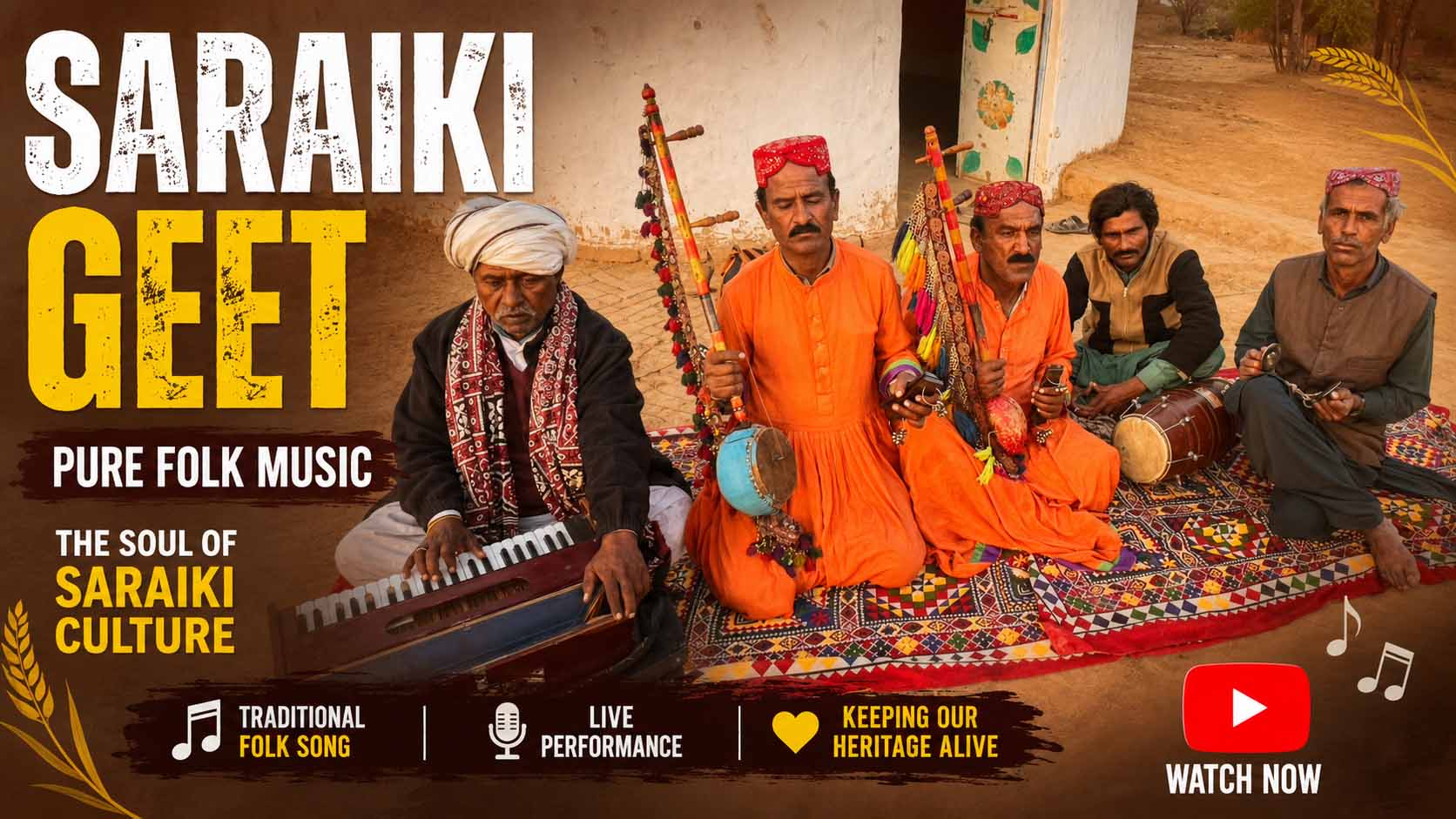
Long before recorded music, the plains of South Punjab found their voice through handmade instruments — reed flutes carved by shepherds, drums stretched with goat hide, and simple string instruments built from gourds and wire. These instruments still anchor Saraiki folk music today.
Each instrument has its own place: some lead the melody, some drive the rhythm at a dance, and some simply keep time in the hands of an elder sitting at the edge of a gathering. Together they accompany Sufi kafi singing, qawwali at shrine festivals, and the joyous music of Saraiki weddings.

A pair of wooden flutes played together, one hand on each, producing the region's signature breathy melody.
A double-reed pipe with a gourd chamber, traditionally linked to snake charmers and wandering minstrels.
A large double-headed drum slung over the shoulder, played with sticks to power the jhumar dance.
A smaller hand-played barrel drum, the mainstay of home gatherings, kafi singing and wedding songs.
Metal fire-tongs fitted with jingling discs, struck and clapped rhythmically by Sufi singers and qawwals.
A one-stringed folk instrument with a gourd or wooden body, plucked to keep a steady drone beneath the vocals.
A bowed short-necked string instrument prized for its voice-like tone in classical and folk singing alike.
At melas, urs festivals and weddings these instruments come together, layering rhythm, drone and melody.
At the shrines of Multan and Uch Sharif, the dhol and chimta drive the ecstatic rhythm of qawwali and dhamaal, while the sarangi and been shade Sufi kafi verses with mournful, meditative tone. At village weddings, the dhol leads the baraat procession and the jhumar dance, while dholak and chimta keep the women's singing circles alive late into the night.
These instruments are inseparable from Saraiki folk music and remain central to wedding traditions and shrine festivals across South Punjab, even as fewer artisans continue to hand-craft them.
Subscribe to receive the latest Saraiki culture stories, poetry and event news.