In Saraiki culture, a wedding is rarely a single event — it is a sequence of gatherings that can stretch across days or even weeks, drawing in extended family, neighbours and the whole biradari (kinship community). Each stage has its own rituals, songs and food, and together they mark the union of two families as much as two individuals.
The celebrations blend joy, ritual and remembrance of ancestors, all carried forward by the voices of women singing traditional songs and the beat of the dhol calling guests to dance. Even in modern times, families in Multan, Bahawalpur and surrounding villages hold firmly to these customs as an expression of Saraiki identity.

The engagement, where families formally agree to the match, often with an exchange of rings and sweets, setting the wedding date and beginning the countdown of preparations.
An evening of henna, bright yellow and orange attire, folk dance and dholak beats, as the bride's and groom's hands and feet are decorated with intricate henna patterns.
In the weeks before the wedding, women gather nightly to sing traditional wedding songs over the beat of a dholki hand-drum, building excitement and bonding the families.
The religious marriage contract, conducted by an Islamic cleric with witnesses from both families, formally and legally uniting the couple.
The groom's wedding procession, historically arriving on horse or camel and accompanied by dhol players and dancing relatives, to formally receive the bride from her family home.
The reception hosted by the groom's family after the wedding night, where a large feast is served to friends and relatives to publicly celebrate the marriage.
Saraiki weddings are inseparable from their music. Suhaag songs, sung by women, express the bride's emotions as she prepares to leave her parents' home, while ghorian are joyful songs sung for the groom, celebrating his journey to marriage. Both traditions are passed down orally through generations of mothers, aunts and grandmothers.
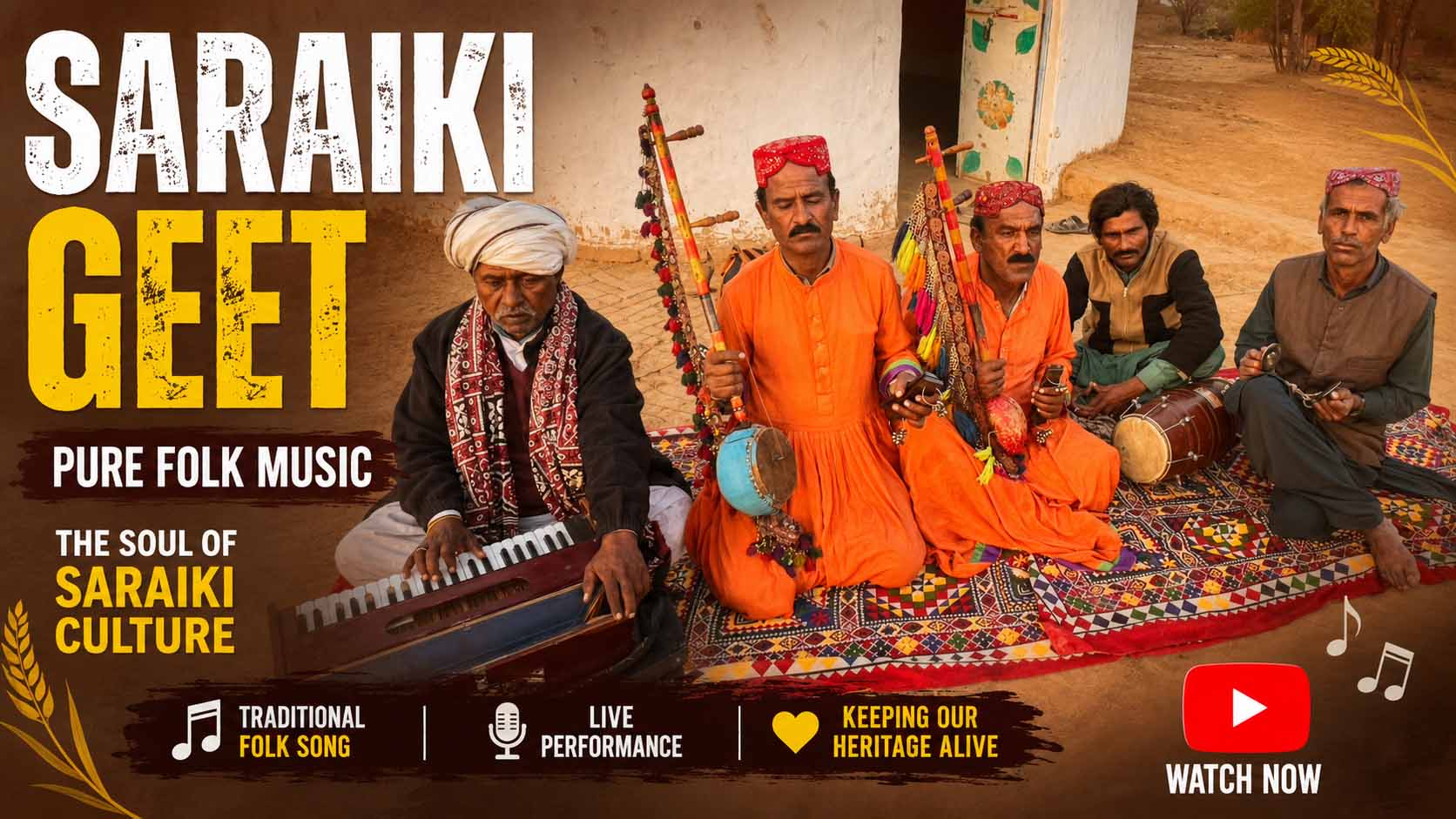
Folk musicians playing the dhol lead the baraat procession and set the tempo for dancing at nearly every stage of the celebration, often joined by the alghoza or been for a fuller folk sound. Explore these instruments in more depth on our Traditional Instruments page.
The sehra, a veil of flowers or beads worn by the groom, and elaborate henna patterns on the bride are among the most visually striking wedding customs, alongside a spread of traditional wedding food — from biryani and karahi to sohan halwa — served generously to guests as an expression of the families' hospitality.

Wedding attire is one of the richest expressions of Saraiki dress — from the bride's embroidered outfit and silver jewelry to the groom's sherwani and sehra.
Traditional Dress Traditional Instruments Back to Culture HubSubscribe to receive the latest Saraiki culture stories, poetry and event news.