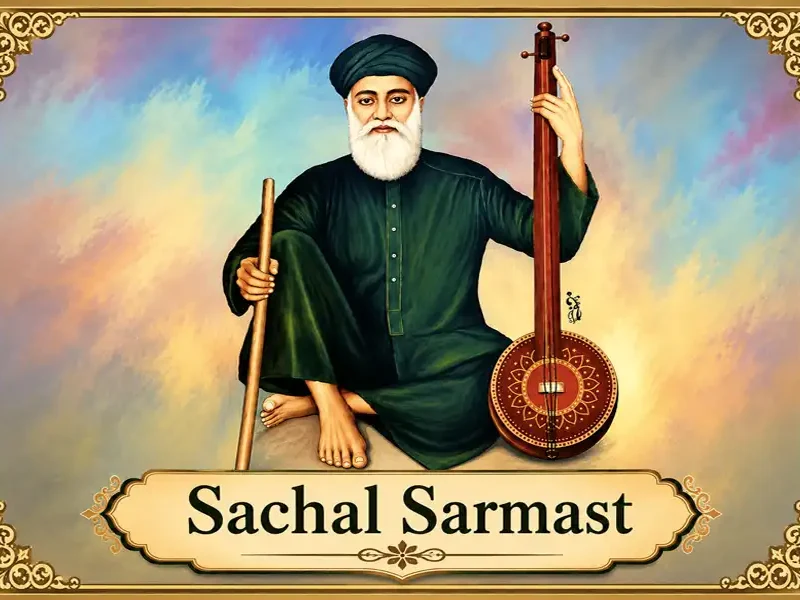
Sachal Sarmast (1739–1827), born Abdul Wahab Farooqi, was a Sufi mystic and poet whose ecstatic verse in seven languages — including Saraiki — earned him the title Shair-e-Haft Zaban, “poet of seven languages.”
Early Life
Sachal was born in Daraza, a village near Ranipur in the Khairpur district of Sindh. He lost his father while still a child and was raised by his uncle, Khwaja Abdul Haq Farooqi, who became both his teacher and spiritual guide. He married his uncle’s daughter, but she died only two years later, and he never remarried, spending the rest of his life devoted to poetry and prayer in Daraza.
The Poet of Seven Tongues
Though best known for his Sindhi verse, Sachal composed freely in Sindhi, Saraiki, Persian, Urdu, Punjabi, Balochi and Arabic, moving between languages within a single poem. His compositions take the form of kafi, vai, kalam and ghazal, and his Saraiki kalam remains sung by folk singers across the Saraiki Wasaib alongside his Sindhi work.
Philosophy: Truth and Divine Unity
Sachal was a devoted follower of Wahdat-ul-Wujood, the Sufi doctrine of the “unity of existence,” which holds that all creation reflects the Divine. His verse pushed against rigid religious orthodoxy of his time, urging seekers toward direct, ecstatic experience of God rather than blind ritual — a boldness that led admirers to call him the “second Mansoor Hallaj,” after the martyred mystic who proclaimed the same truth.
Legacy
Sachal died in 1827 and is buried at his shrine in Daraza Sharif, Khairpur district, where an annual Urs draws pilgrims, singers and scholars from across Sindh and the wider Saraiki Wasaib. His work is still performed by folk singers in Sindhi and Saraiki, and he remains one of the towering figures of Sufi literature, discussed on our Saraiki poetry page alongside his contemporaries.
Sachal Sarmast at a Glance
- Born: Abdul Wahab Farooqi, 1739, Daraza, Sindh
- Died: 1827, Daraza Sharif
- Title: Shair-e-Haft Zaban (“Poet of Seven Languages”)
- Philosophy: Wahdat-ul-Wujood (Unity of Existence)
- Languages of composition: Sindhi, Saraiki, Persian, Urdu, Punjabi, Balochi, Arabic
- Shrine: Daraza Sharif, Khairpur district, Sindh