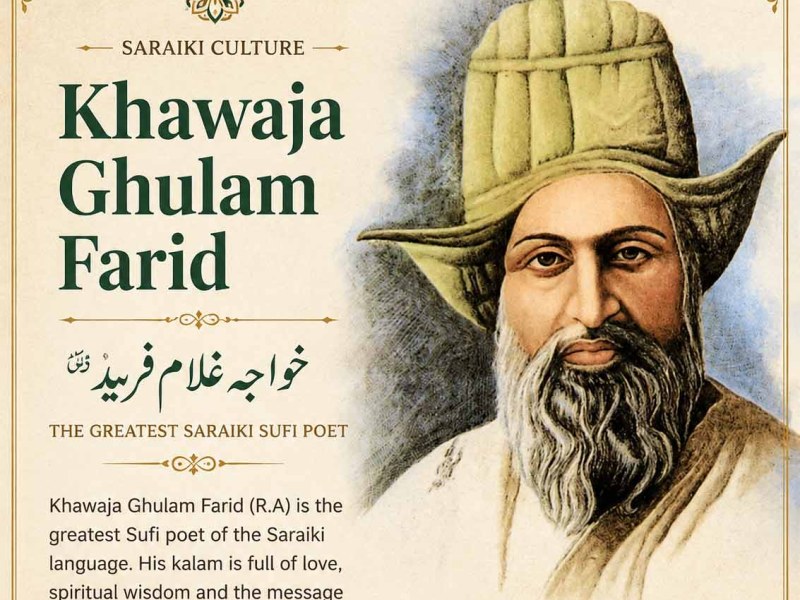
Khwaja Ghulam Farid (1845–1901) is remembered as the towering figure of Saraiki literature, the Sufi poet whose Diwan-e-Farid gave the kafi its enduring place as the soul of the Saraiki language.
Early Life and Spiritual Path
Farid was born in 1845 at Chachran Sharif on the banks of the Indus, into a family of the Chishti Sufi order. Orphaned as a child, he was raised and spiritually trained by his elder brother, Khwaja Fakhr Jahan, and grew up steeped in Sufi learning amid the desert landscape of Cholistan. He eventually settled at Kot Mithan, in what is now Rajanpur district, which remains the seat of his shrine to this day.
The Diwan-e-Farid and the Art of the Kafi
Farid’s collected verse, the Diwan-e-Farid, is built around the kafi — a short, musical form of Sufi lyric sung rather than merely read. Composed mainly in Saraiki, with passages in Sindhi, Urdu and Persian, his kafis are structured around a repeating refrain and a handful of verses that build a single, intense mood: separation, longing, or union with the divine Beloved.
Themes: The Desert, Divine Love and Longing
Farid drew constantly on the landscape of his native Rohi (Cholistan) desert — its dunes, camel caravans, thorn bushes and scorching heat — as a mirror for the soul’s yearning for God. Writing often in the voice of a woman separated from her beloved, a convention common to South Asian Sufi poetry, he turned the harshness of desert life into a language of spiritual devotion, drawing too on local folk romances to express the pain and ecstasy of the mystical path.
Legacy
Farid died in 1901 and is buried at his shrine in Kot Mithan, where the annual Urs of Khwaja Ghulam Farid still draws devotees, singers and poetry lovers from across the Saraiki Wasaib. His kafis remain the most widely sung poetry in the language, performed at shrines and festivals and on our Saraiki folk music page, and he is honoured as the defining voice of Saraiki poetry.
Khwaja Ghulam Farid at a Glance
- Born: 1845, Chachran Sharif
- Died: 1901, Kot Mithan
- Sufi order: Chishti
- Major work: Diwan-e-Farid
- Poetic form: Kafi
- Shrine: Kot Mithan, Rajanpur district