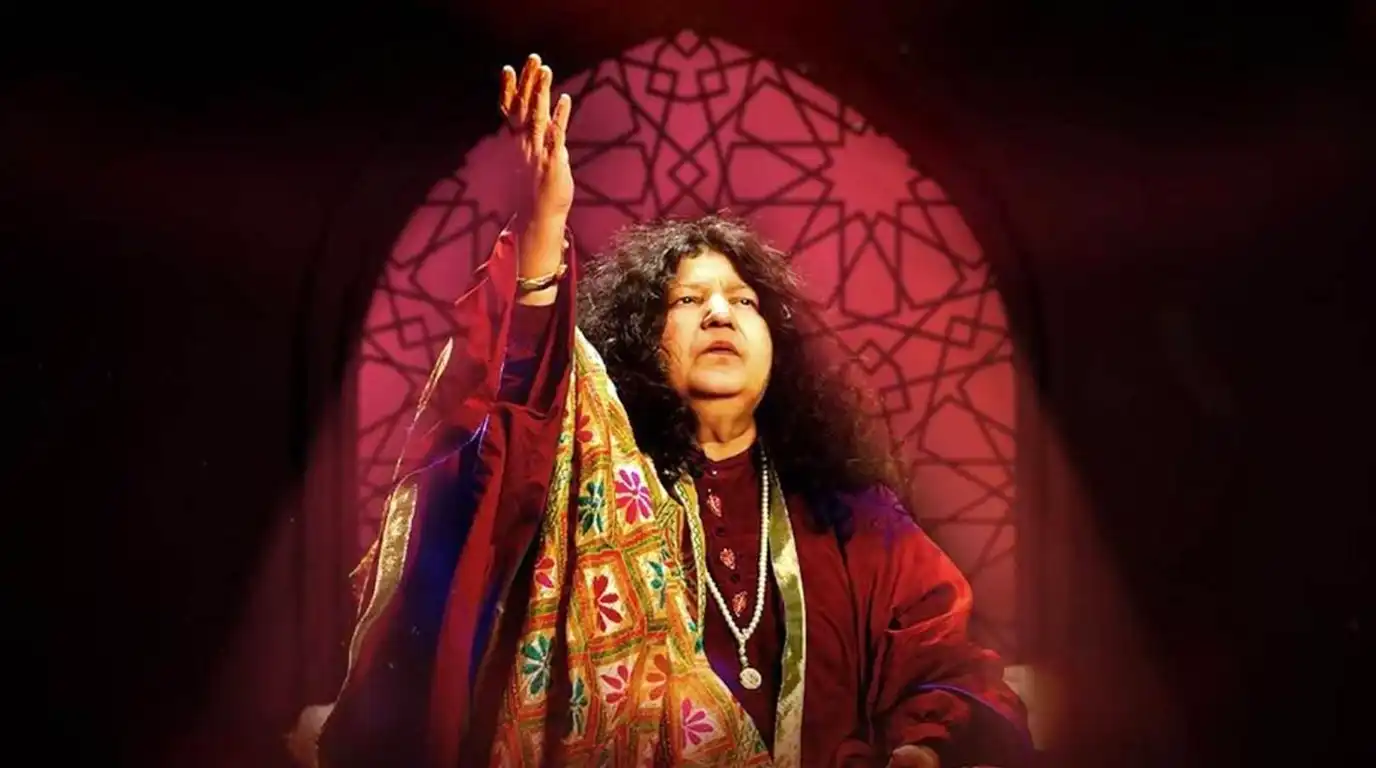
Abida Parveen (born 20 February 1954) is a Pakistani vocalist widely regarded as the world’s leading exponent of Sufi kafi and mystic poetry, often dubbed the “Queen of Sufi Music.” Born in Ali Goharabad, Larkana, Sindh, into a family of musicians, she was trained from early childhood by her father, Ustad Ghulam Haider, a respected singer and teacher who ran his own devotional music school. Recognising her exceptional talent, he chose her as his musical heir over his two sons, and she sang her first complete kalam at the age of three.
Abida Parveen achieved her breakthrough in 1973 on Radio Pakistan with the Sindhi song “Tuhinje Zulfan Jay Band Kamand Widha,” and was formally introduced as an official Radio Pakistan singer in 1977. She went on to become one of the most celebrated interpreters of Sufi poetry in Urdu, Sindhi, Punjabi, Saraiki, Persian and Arabic, drawing on the verses of Bulleh Shah, Shah Abdul Latif Bhittai, Amir Khusro and Khwaja Ghulam Farid, among many others.
Her soaring, impassioned renditions of songs such as “Tere Ishq Nachaya” and “Yaar Ko Humne Ja Baja Dekha” carried her voice far beyond Pakistan, and since the early 1990s she has performed at major international venues, including London’s Royal Albert Hall and Wembley Conference Centre, and at Sufi music festivals across Europe and North America. Her 2014 Coke Studio duet with Rahat Fateh Ali Khan, “Chaap Tilak,” introduced her artistry to a new generation of listeners worldwide.
In recognition of her contribution to music and culture, Abida Parveen has received Pakistan’s highest civilian honours, including the Pride of Performance (1984), Sitara-e-Imtiaz (2005), Hilal-e-Imtiaz (2012) and the Nishan-e-Imtiaz (2021) — Pakistan’s highest civilian award. She continues to perform and record, carrying forward the Sufi message of love, unity and devotion that has defined her six-decade career.
Subscribe to receive the latest Saraiki culture stories, poetry and event news.